
The following text field filters the results that follow as you type.


Practical steps for accountants to innovate and expand services while managing risk.
Published on 9 December, 2025
The accountancy sector isn’t just changing – it’s accelerating. Technology, economic headwinds, and consolidation are rewriting the rules of engagement. For firms that want to stay ahead, the question isn’t if you adapt, but how you do it effectively and without adding risk or cost.
In this article, you’ll discover:
The three forces reshaping accountancy;
Why they matter for your margins and client relationships;
The practical steps firms are taking to turn these challenges into growth opportunities with minimal risk or cost.
1. Technology and AI: promise meets reality
AI is no longer a future concept. It’s here, and clients are embracing it fast. Nearly six in ten UK taxpayers plan to use AI tools for self-assessment, signalling a shift in expectations. But here’s the catch: the technology isn’t ready to deliver what they assume.
Accountants know the risks. Research shows:
- 73% worry AI produces incomplete advice.
- 62% say it struggles with nuance.
- 52% highlight gaps in UK-specific tax knowledge.
The result? Misaligned expectations and costly rework – up to 200 extra hours per 100 assessments. For firms already under pressure, that’s not just inefficiency; it’s margin erosion.
Implication: AI hype is warping client expectations. When technology falls short, accountants are left to pick up the pieces, absorbing the cost and strain of fixing errors.
AI isn't just a trend; it's a source of growing complexity.
2. Macroeconomic pressures: the margin squeeze
Serving clients is getting more expensive, and fees aren’t keeping pace. Between 2021 and 2023, median partner fees rose by 13%, while inflation climbed 17%. That gap tells a bigger story: rising costs are outstripping firms’ ability to charge more.
The implication is a structural pricing problem. When firms assign value to outcomes, the maths falls short. Client expectations remain high, but commercial models can’t stretch far enough to protect margins.
This isn’t just a financial challenge; it’s a strategic one. Practices are being forced to do more for less, while absorbing cost pressures that erode profitability. Without a new approach, the squeeze will only tighten.
3. Industry consolidation: the scale advantage
The race to scale is accelerating. Nearly half of mid-tier firms have acquired another practice recently, and more than half plan to do so within the next three years.
Why does this matter? Larger, consolidated firms can deliver more services at lower cost. That resets the benchmark for everyone else. Clients start expecting “big firm” capability at “small firm” prices, creating a ripple effect that drives pricing pressure across the market.
Combine that with rising costs and you get a double squeeze: consolidation amplifies macroeconomic pressures, leaving smaller practices struggling to compete on both price and breadth of service.
The takeaway is that consolidation is a competitive reset. Firms that don’t adapt risk being left behind.
Customer expectations: the signal amidst the noise
The good news is that trends shift, technology advances, markets consolidate, yet one constant remains: what clients value most.
Jeff Bezos famously noted that while features change, fundamentals endure. His example for Amazon was simple: low prices, fast delivery, and choice will never go out of fashion. These are timeless expectations, unaffected by the latest technological wave.
For accountancy, the equivalents are clear: accuracy, clarity, responsiveness, frictionless service, and trust. These qualities are not optional; they are the bedrock of client relationships. They persist even as the surrounding environment evolves, and tech trends rise and fall.
The firms that succeed are those that strengthen these foundations in spite of the constraints they find themselves in. In short: the noise will keep changing, but the signal does not.
Where are the opportunities to exceed client expectations?
Think of the accountancy landscape as four quadrants: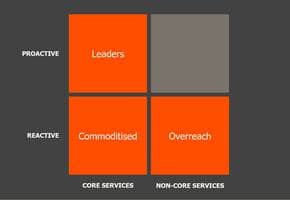
- Bottom-left: Firms delivering core services reactively, the traditional compliance model.
- Bottom-right: Reactive delivery of non-core services, often ad hoc and unstructured.
- Top-left: Industry leaders delivering core services proactively, competing on efficiency and insight.
- Top-right: The blank space, proactive delivery of both core and non-core services. This is the high-value frontier where firms deepen relationships and create loyalty.
Historically, the top-right quadrant has been considered risky. It demands new capabilities, additional staff, and operational investment. But it’s also where the greatest opportunity lies, moving beyond compliance to become a trusted advisor across a broader spectrum of client needs.
The challenge? Doing this without adding cost or complexity. That’s where innovative solutions come in – enabling firms to occupy this space without the traditional barriers.
Expanding your non-core offering – without the risk
Clients increasingly look to their accountants for guidance beyond traditional compliance. Questions like “Are we GDPR compliant?”, “How should I handle this staff grievance?”, or “Can you review this contract?” are common, and they represent clear pain points.
For most SMEs, hiring a lawyer isn’t an option. That creates an opportunity for firms to add value by offering non-core services that strengthen client relationships and differentiate their practice. But historically, moving into this space has meant new staff, specialist knowledge, and operational complexity – all high-risk investments.
Today, that barrier is gone. Platforms such as Markel’s Business Hub, included as a plug-and-play solution with your Fee Protection policy, enable firms to deliver this support seamlessly under their own brand, at no additional cost to you or your clients.
With over 900 solicitor-drafted templates, detailed guides on everyday business issues, and a 24/7 legal chat facility, accountants can provide clients with practical solutions without adding risk or complexity.
As a result, you occupy the top-right quadrant: proactive delivery of both core and non-core services, without the overhead. It’s a strategic move that deepens trust, creates new revenue opportunities, and helps clients grow with confidence.
As margins are tightening, client expectations aren’t. The firms that thrive will be those that innovate without adding risk.
Markel’s Business Hub, delivered as part of your Fee Protection policy at no extra cost, gives you a practical way to expand your services, strengthen client relationships, and move into the high-value quadrant – all under your own brand, with minimal complexity.
Ready to unlock new opportunities?
